The Law Office of Blerim Elmazi

Who Can Be Held Liable for Sexual Assault in Texas?
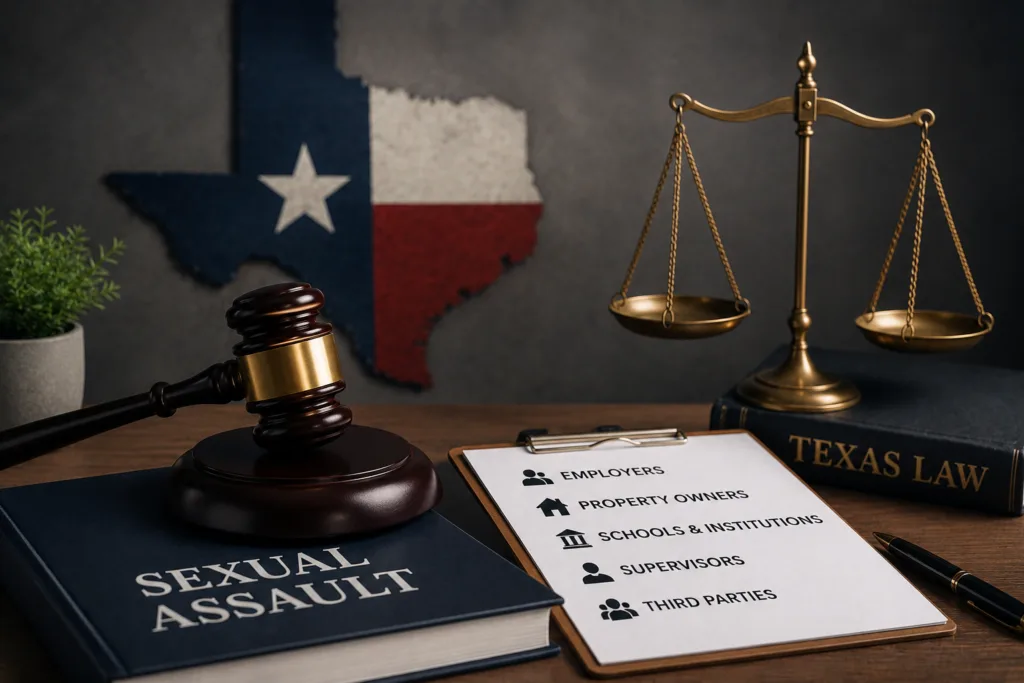
When someone thinks about a sexual assault lawsuit, the first and often only person that comes to mind is the perpetrator. But under Texas law, liability frequently extends well beyond the individual who committed the assault. Employers, property owners, and institutions can all bear legal responsibility when their negligence made the assault possible. At Elmazi Law, we represent survivors of sexual abuse and sexual assault throughout Dallas/Fort Worth, and identifying every party who share responsibility is often the difference between a case that recovers nothing and one that delivers real accountability.
This guide breaks down who can be held liable for sexual assault in Texas, the legal theories that apply to each, and why pursuing more than just the perpetrator matters.
The Individual Perpetrator
The most direct claim is against the person who committed the assault. Civil claims against a perpetrator can include assault, battery, and intentional infliction of emotional distress. Unlike a criminal case, a civil claim does not require a conviction, and it can proceed even if criminal charges were never filed or the accused was found not guilty, because civil cases use a lower burden of proof.
The challenge with suing only the individual is practical: many perpetrators do not have significant personal assets, which can make a judgment difficult to collect even if the case is won. This is one of the main reasons it is so important to look beyond the individual for other legally responsible parties.
Employers
When an assault is committed by someone acting in a work capacity, such as a caregiver, delivery driver, contractor, or staff member, the employer may share liability under a few different legal theories:
- Negligent hiring — the employer failed to conduct a reasonable background check or ignored red flags before hiring
- Negligent supervision — the employer failed to properly oversee an employee’s interactions with clients, customers, or the public
- Negligent retention — the employer kept an employee on staff after learning of prior complaints or warning signs
These claims focus on what the employer knew, or should have known, and what they did or failed to do in response.
Property Owners and Businesses (Negligent Security)
Sexual assault often occurs on someone else’s property, such as an apartment complex, hotel, parking garage, nightclub, or workplace. When that happens, the property owner or business may be liable under a theory called negligent security if they failed to take reasonable steps to protect people on their property.
A property owner or business may be liable if:
- There were prior similar incidents on the property that were ignored
- Security cameras were broken or not monitored
- Lighting in parking lots, stairwells, or hallways was inadequate
- Security personnel were insufficient, absent, or improperly trained
- Locks, gates, or access controls were broken and not repaired
These cases often come down to foreseeability: whether the property owner knew, or reasonably should have known, that the property posed a risk and failed to act on it.
Institutions
Schools, churches and religious organizations, youth programs, camps, and care facilities all have a duty to protect the people in their care. When an institution fails in that duty, it can be held liable alongside the individual who committed the assault.
Common examples of institutional liability include:
- A school or youth program ignoring reports of inappropriate conduct by staff or volunteers
- A religious institution transferring or reassigning someone accused of misconduct instead of removing them
- A care facility failing to screen or supervise staff who have direct access to vulnerable residents
For a deeper look at how these principles apply specifically to religious institutions, see our article on who can be held liable in a church sexual assault case in Texas.
What You Need to Prove Against a Third Party
Claims against employers, property owners, and institutions are generally built on negligence, which requires proving four elements:
- Duty — the party had a legal responsibility to protect people in that setting
- Breach — the party failed to meet that responsibility
- Causation — that failure contributed to the assault taking place
- Damages — the survivor suffered real, provable harm as a result
Building this kind of case typically requires investigating prior incidents, internal records, hiring and training practices, and safety policies, which is why early legal involvement matters.
Why Identifying Every Liable Party Matters
Most sexual assaults are committed by someone the victim already knows.
RAINN’s national data shows that roughly three out of every four rapes are committed by someone known to the victim, not a stranger. This matters legally because it means the responsible parties are often closer to home than people expect: a caregiver’s employer, an apartment complex, a school, or a religious organization, all of whom may carry insurance coverage that the individual perpetrator does not.
Pursuing claims against every legally responsible party can significantly affect the outcome of a case in two ways: it increases the total compensation potentially available, and it holds accountable the organizations whose negligence allowed the harm to happen in the first place, which can also prevent future victims.
How an Attorney Investigates Liability
Initial Consultation — an attorney reviews the facts of what happened and identifies every potentially responsible party, not just the individual involved.
Evidence Gathering — this can include incident reports, security footage, employment records, prior complaints, and internal policies.
Investigating Prior Knowledge — attorneys look for evidence that a business, employer, or institution knew or should have known about a risk and failed to act.
Filing Against All Responsible Parties — once liability is established, claims are filed against each party whose negligence contributed to the harm.
What Damages Can You Recover?
Depending on who is found liable, survivors may be able to recover:
- Medical expenses and future treatment costs
- Therapy and counseling costs
- Lost wages and loss of earning capacity
- Pain and suffering
- Emotional distress and mental anguish
- Punitive damages, in cases involving egregious negligence
For a full breakdown of the process, timelines, and legal options available, see our guide on how to file a civil sexual assault lawsuit in Texas, and our article on what evidence you need to win a sexual assault lawsuit in Texas.
Frequently Asked Questions about Sexual Assault Liability
Can I sue someone other than the person who assaulted me?
Yes. Depending on the facts, employers, property owners, and institutions can all be held liable if their negligence contributed to the assault, in addition to any claim against the individual perpetrator.
What if the perpetrator doesn't have money to pay a judgment?
This is exactly why identifying other liable parties matters. Employers, property owners, and institutions often carry insurance coverage that can make a judgment collectible even when the individual perpetrator cannot pay.
Do I need proof the property owner or employer knew about the risk?
Generally, yes. Most third-party claims require showing the party knew, or reasonably should have known, about a risk and failed to take reasonable steps to address it. An attorney can help investigate whether that evidence exists.
How long do I have to file a claim in Texas?
Deadlines vary depending on the circumstances of the case and the age of the survivor at the time of the assault. See our article on the statute of limitations for sexual assault in Texas for more detail.
Do I have to pay upfront legal fees?
Many sexual assault cases are handled on a contingency fee basis, meaning you pay nothing upfront and attorney’s fees are paid only if compensation is recovered.
When to Contact a Texas Sexual Assault Attorney

If you are unsure who may be responsible for what happened to you, that uncertainty is exactly what a consultation is for. Elmazi Law represents survivors throughout Dallas/Fort Worth, and every consultation is confidential.
Contact our office today for a free, confidential consultation: elmazilaw.com/contact-us
Fill out the Form Below to Get in Touch
By submitting this form, you agree to our Privacy policy
Contact Info
3010 LBJ Fwy. Suite 1450, Dallas, TX 75234
Phone: (682) 888-0091
Email: blerim@elmazilaw.com